Showing posts with label 1990. Show all posts

Friday, 22 October 2010

Three Generations (1990) Norval Morrisseau and The Academy (2008) by Kent Monkman

Three Generations
Norval Morrisseau
1990, acrylic on canvas - Dyptch - 96" x 48"
_________________________________


This brilliant painting is available to purchase NOW through Principal Morrisseau art dealer Bryant Ross of Coghlan Art in B.C.. Isn't it astonishing that art like this is still available on the open market? Imagine Picasso's like this floating around 3 years after he passed away. This is a museum piece. No doubt about it.

Friends came into town recently from Vancouver and England. I let them use my Art Gallery of Ontario membership card and told them to check out the multi-panel, "Man Changing into Thunderbird" by Morrisseau. I also told them to check out the Rembrandt of Cree artists, Kent Monkman's, portrayal of Norval in a long house, entitled, "The Academy".

The Academy
Kent Monkman
72” x 108”, 2008, acrylic on canvas
Collection of the Art Gallery of Ontario

The Academy
 - (Detail of Morrisseau / Vermeer) -

When one great artist paints another great artist into his painting, it says a lot about both artists.

My friends agree with me. Morrisseau's mural in the main foyer of the AGO is the single most dynamically charged artwork at the AGO. So much of the art in the AGO is wonderful in so many ways, including Monkman's awesome work of art, yet nothing rivals Norval's work for pure Shamanic power. i.e. Spirit Medicine.

______________________________


Tuesday, 17 August 2010

Time Track / Causal Plane (1990) Norval Morrisseau

The R.E. Mansfield Collection, 949 works in all, was divided between the University of Oklahoma's Fred Jones and the Smithsonian's National Museum of the American Indian.

Time Track / Causal Plane
Norval Morrisseau
1990, acrylic on canvas, 36" x 30"
Gift of Dr. and Mrs. R.E. Mansfield, 2003 (Probably acquired in White Rock B.C.)

___________________________

OU MUSEUM OF ART RECEIVES NATIVE AMERICAN TREASURES

The Fred Jones Jr. Museum of Art has acquired another major collection - 476 works by some of the world's most celebrated Native American artists. The R.E. Mansfield Collection, 949 works in all, was divided between the University of Oklahoma's Fred Jones and the Smithsonian's National Museum of the American Indian. The gift, which includes ceramics, paintings, beadwork, sculpture and textiles, will augment the OU museum's already strong collection of Native American art.

The terms of the gift were unusual. R.E. Mansfield stipulated that it was his desire to see his collection divided evenly between the two museums he felt would be in the best interests of his Native American masterpieces. Mansfield chose the Smithsonian's National Museum of the American Indian and the University of Oklahoma's Fred Jones Jr. Museum of Art. The task of amicably dividing the nearly 1,000 works was left to the directors and staff of each museum.

 After negotiations, Eric Lee, director of the Fred Jones and Bruce Bernstein, chief curator of the Smithsonian's N.M.A.I. decided the only fair thing to do was to lay out the entire collection in one place and take turns selecting the pieces one at a time. Since the collection already was at the Fred Jones, the selection process took place on the OU campus in Norman.

 "The selection process was exhilarating," said Lee. "The Smithsonian's National Museum of the American Indian, which opens its new building on the Mall in Washington in September, has one of the leading collections of Native American art in the world and Bruce Bernstein is one of the nation's leading authorities. We were under a lot of pressure, but I am thrilled with the result. We are also very grateful to Mr. Mansfield for the gift of this incredible collection."

 Lee said that one of the great strengths of the Mansfield Collection is the ceramics. He said the collection has stunning examples of all the major potters of the Southwest, including dozens by historic figures like Maria Martinez and Margaret Tafoya.

"We now have an extremely strong collection of Marias," said Lee. "We also are much stronger in contemporary Native American painters with the addition of major works by such as artists Norval Morrisseau and Emmi Whitehorse." Lee said the Mansfield Collection is impressive in both quality and range of media. "We have beadwork by Marcus Amerman and also quite a bit of prehistoric material, as well as historic pots from the late 19th and early 20th century," he said. "We now have additional weavings from the 19th century and have filled the gaps in our collection, like Native American art from the Pacific Northwest."

 The Fred Jones is undergoing a $14-million renovation and construction project, designed by Washington, D. C. architect Hugh Newell Jacobson. The Mary and Howard Lester Wing will double the size of the existing facility and provide much needed gallery space for the museum's permanent collection, including the Weitzenhoffer Collection of French Impressionism. When the museum reopens in fall 2004, Native American art will have a permanent place in the renovated galleries.
Fred Jones Jr. Museum of Art
December 17, 2004


Dr. Mansfield was an American citizen who was a dedicated collector of Native American art. He considered Norval Morrisseau to be the greatest Indian artist on the continent. His donated collection of almost 1000 works of North American Indian art and pottery included quality authentic Morrisseau paintings and prints along with several "questionable" Morrisseau paintings.

The two American Museums split their take on one day and then went back to the business of educating the World about Indians and their Art.

Purported Morrisseau artwork acquired by the Fred Jones Jr. Museum and the Smithsonian from Dr. and Mrs. R.E. Mansfield in 2003 that in my studied opinion are forged pieces include

Storyteller of the Ages , dated 1980 - Fred Jones Jr. Museum
Early Shaman, dated 1973 - The Smithsonian
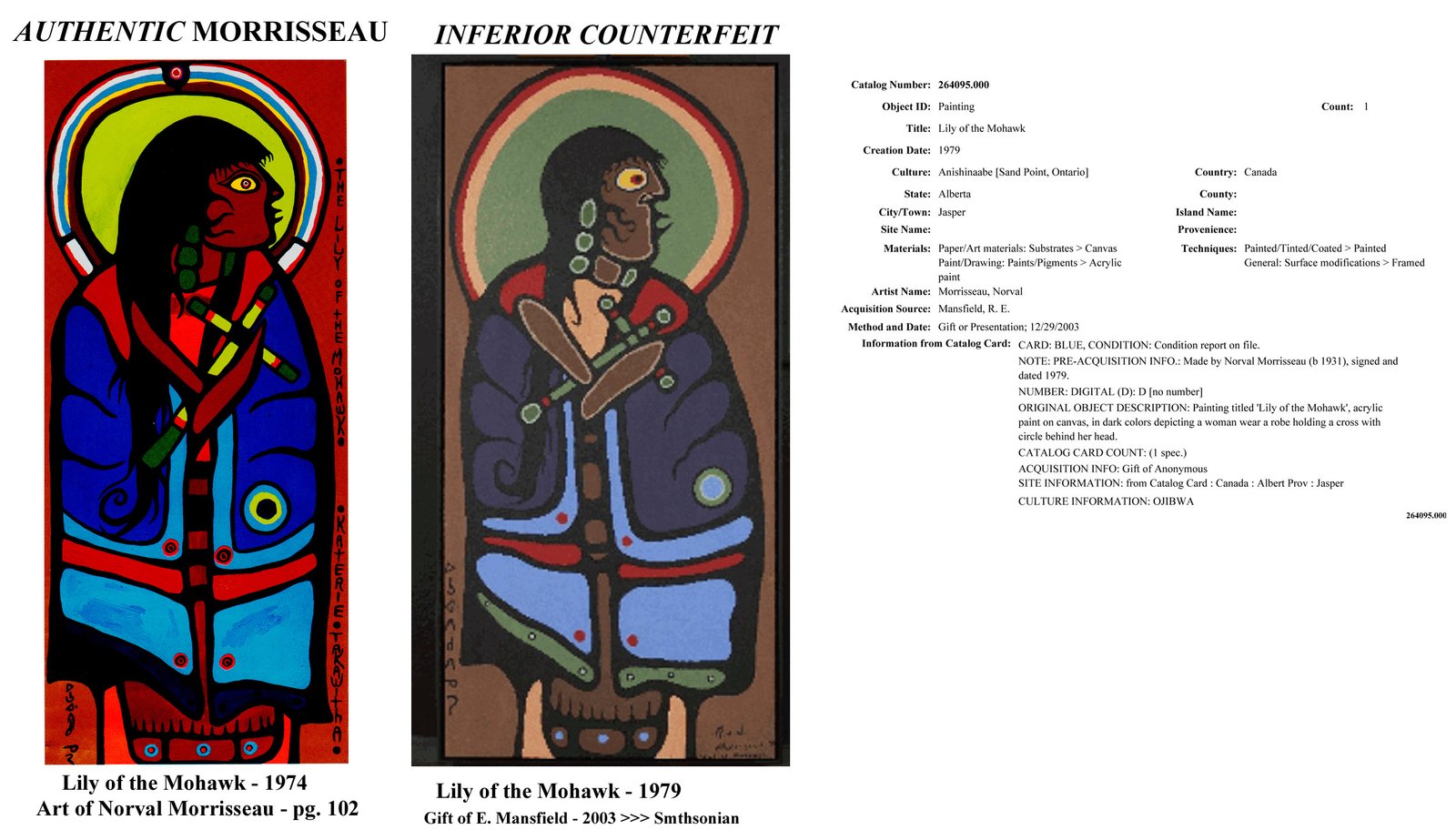
Lily of the Mohawk, dated 1979 - The Smithsonian
Mother To All Things, dated 1980 - The Smithsonian
The Wanderers, dated 1985 - The Smithsonian (On tour in Australia)


Authentic Morrisseaus donated by Dr. and Mrs. R.E. Mansfield include

Time Track / Causal Plane , date created 1990 - Fred Jones Jr. Museum
Psychic Space, date created 1996 - The Smithsonian
Meeting with Thunderbird, date created 1994 - The Smithsonian
Together We are All One Spirit, date created 1992 - The Smithsonian

Stardreamer


View "Lily of the Mohawk" authentic and forged Morrisseau paintings side-by-side

Monday, 16 August 2010

To the Land of Myth (1990) Norval Morrisseau

To the Land of Myth
"Journeys with the Shaman, grandson and bear entity to the Land of Myth"
Norval Morrisseau
57" x 34", acrylic on canvas, 1990

________________________

Norval Morrisseau found a Paris salon
 in the boreal forest

Remembering the Ojibway painter's early start in the mining town of Cochenour, Ont.

One of the most unlikely and fruitful encounters in Canadian art history took place just up the hill from the street I grew up on in Cochenour, a lakeside mining town in northwestern Ontario. It happened in 1957 or 1958, before my time, in the doctor’s house, just across from the post office. The town doctor at that time was Joseph Weinstein, who, along with his wife, Esther, had only a few years earlier been living in Paris, where they hung out with leading avant-garde artists, writers, and intellectuals. Joseph painted abstracts and Esther had studied languages at the Sorbonne.

But it was in Cochenour, a long way from Montparnasse, that the couple made a lasting contribution to art. There they met a young Ojibway man named Norval Morrisseau who was struggling to become a painter. Esther saw something arresting in his early efforts. They helped him. As art historian Ruth Phillips recounts in her catalogue essay for last year’s National Gallery of Canada exhibition Norval Morrisseau: Shaman Artist, the Weinsteins gave Morrisseau high-quality artist’s paper and paints, and some pointers on technique. Perhaps more importantly, they invited him to pore over the collection of art books they had brought with them to the little doctor’s house, exposing his hungry eye to ancient and modern paintings, and, intriguingly, to other indigenous art.

What an intersection: Morrisseau steeped in his grandfather’s tales from Ojibway legend, the Weinsteins in the European art tradition. There were to be many other chapters, of course, in the Morrisseau saga, which ended this week with the grand old painter’s death at 76. But I’ve been thinking about his good fortune in that initial real exposure to the world of art that he was desperate to conquer. Far too often, to my mind, discussion of First Nations art concentrates on themes of racism and paternalism. It’s worth remembering, as we consider Morrisseau’s remarkable career and substantial legacy, that his first important and formative experience with white people who cared deeply about art was apparently entirely sympathetic without being, by the accounts I’ve heard and read, at all condescending.

Lucky Morrisseau. Lucky Weinsteins. The greatest nascent artistic talent on the Canadian Shield finds his way into the only Paris-influenced salon in the entire boreal forest—what were the odds? But unique as their relationship was, the pattern it represents is not so unusual. The repeated cross-pollination of Aboriginal and Western art traditions was one of the most important elements in 20th-century cultural history in Canada. And it was not a matter of exploitation, at least not in the case of Morrisseau or the other First Nations art success stories that rank with his, notably the way Inuit and West Coast styles worked their way into our popular conception of a Canadian visual art heritage.

Consider the way Inuit sculpture and then prints became ubiquitous. James Houston shows up in Inukjuak with his sketch books in 1948, not long away from painting live models in art classes in London and Paris. Within days, a small carving of a caribou is pressed into his hand. And that leads to him becoming a sort impresario for Inuit art, encouraging the carvers to make bigger sculptures and getting the finished product to big-city galleries down south. Later he brings Japanese print-making technique to Cape Dorset. We’re so used to them now that it’s hard to recapture the proper sense of amazement at the way it all worked out: a white guy shows Inuit artists how to use Asian methods, and the outcome seems perfectly natural—and eminently marketable.

Then there’s Bill Reid. He didn’t know anything about his First Nations heritage until he was a teenager(his mother was Haida). He trained in the very European tradition of jewellery-making and engraving. Yet his personal discovery and exploration of his Aboriginal side led directly to a Haida art renaissance and our national recovery of that incomparably rich patrimony. Robert Bringhurst, an American-born poet and translator, has brought us great literature to go with Reid’s memorable sculpture, through his acclaimed translations of Haida mythic poetry.

These stories all have their own texture and details, but they share something crucial, and somewhat controversial among those who believe majorities can only oppress minorities. In all these cases, the dominant stream of Western art, through the agency of inspired individuals who live by its values, found ways to see Aboriginal art, revere it, absorb it, and help transmit its essence to a very wide and receptive audience. We love the sinewy black lines and flat fields of colour in Morrisseau’s Woodlands school, the accessible Arctic images of Inuit prints and sculpture, the elegant form lines of Haida image-making. We also, it must be admitted, snap up Eskimo kitsch, third-rate Morrisseau rip-offs, and plastic Made-in-China totem poles.

But on Morrisseau’s death, I’m resolved to leave the evident shortcomings in the way First Nations art has been turned into our national art for another day’s reflection. And I’m going to try not to dwell unduly on the stories about curators who belittled his paintings or relegated them to museums of anthropology, rather than their proper place in galleries of fine art. Instead,

I’m imagining him as a tall young man in the home of the Weinsteins, with all those art books around him, and all his own great art still to come.

John Geddes
Dec 5, 2007